Columbia County Home Won't Sell in 2026? Here's the Rental Math
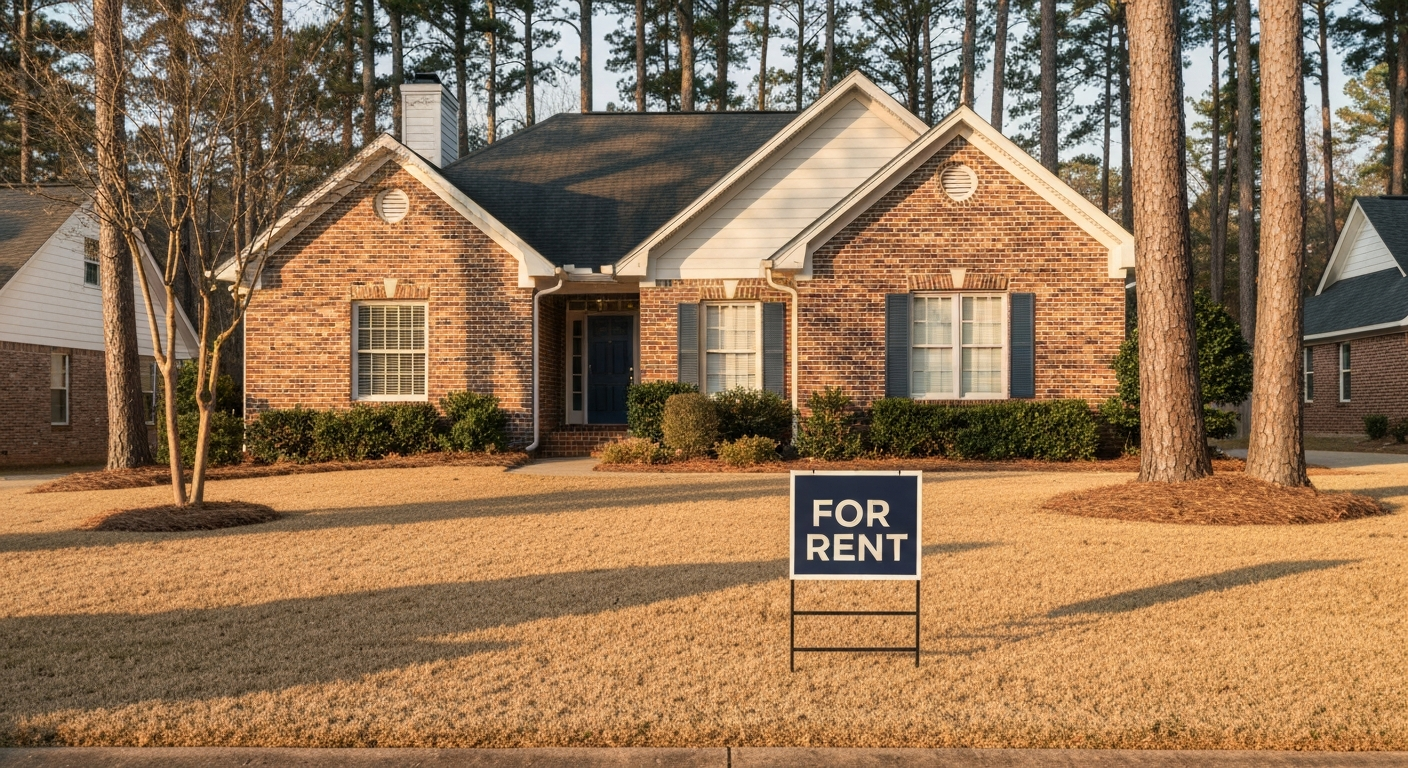
Should you convert your Columbia County home to a rental when it won't sell at your price? In the CSRA's 2026 buyer's market — with supply hitting 7+ months and homes averaging over 100 days on market — renting is the financially stronger move for many owners. A Grovetown or Evans 3-bedroom home can generate $2,200–$2,800 per month in rent. Whether that beats selling at a discount depends on your mortgage balance, your tax window, and what you're willing to take on as a landlord.
You listed your Evans home in January. You priced it at what felt like fair — maybe a touch optimistic, but reasonable for the neighborhood. Since then, you've sat through two price reductions, four showings, and one offer that came in so far below your walk-away number that you wondered if the buyer's agent had pulled comps for the right zip code.
Welcome to Columbia County's 2026 housing market. Months of supply in the greater Augusta area climbed to 7.67 as of February 2026 — up from 2.19 a year earlier, a 250% jump, according to Houzeo's Augusta housing market data. In that environment, 83% of active listings saw price reductions, and homes that did sell closed at an average of 95.26 cents on the listed dollar. Median days on market in Columbia County hit 107 — up from 97 the prior year.
The question in front of you: keep cutting, or do something different?
For some owners in your position, renting the home is the right answer. Not as a fallback, but as a deliberate financial decision that can outperform a discounted sale when you run the full numbers. For others, the math points the other way. The only way to know which camp you're in is to actually work through the calculations — which is what this guide does.
What the 2026 Columbia County Market Data Tells Sellers
The inventory numbers above are not a blip. They reflect a structural shift in the CSRA's housing supply picture: new construction in Grovetown, Harlem, and along the Horizon South Parkway corridor came online in volume just as mortgage rates kept buyer pool sizes constrained. The result is a market with real negotiating power on the buyer side.
Redfin data for Columbia County shows the county's median sale price around $319,000 in recent months, down approximately 6% year over year. That softening is meaningful in dollar terms: a $340,000 listing that would have moved in 48 hours in 2022 may now need to be repriced to $315,000 — and still sit.
For a homeowner who bought at $230,000 in 2017 and has 40% equity, absorbing a $25,000 price cut is painful but survivable. For someone who bought at $295,000 in 2021 and tapped their equity in 2023, the same price cut may produce a closing table where they write a check rather than receive one.
That second scenario is the profile this post is written for. Someone who did not plan to become a landlord, but who is looking at the numbers and asking: is there a third option?
There often is.
The Rental Income Math for Columbia County Homes
Before you can decide whether renting beats selling, you need a market rent number — not a guess, and not a national platform's estimate based on aggregate apartment data. You need what 3-bedroom homes in your specific neighborhood are actually leasing for today.
For Columbia County in mid-2026, here's what the data shows:
| Area | Size | Monthly Rent Range |
|---|---|---|
| Grovetown | 3BR/2BA | $2,200 – $2,800 |
| Evans | 3BR/2BA | $1,900 – $2,500 |
| Martinez | 3BR/2BA | $1,700 – $2,200 |
| Grovetown | 4BR/3BA | $2,500 – $3,100 |
Grovetown rent figures come from RentCafe's Grovetown market data as of March 2026. Evans and Martinez figures reflect comparable active listings that McBride PM tracks in the area. Move-in-ready homes with updated kitchens and baths land at the top of these ranges; homes with dated finishes or deferred maintenance land at the bottom.
One more factor that works in your favor right now: timing. Military PCS season — roughly May through August — is the single strongest rental leasing window in the CSRA. Fort Gordon generates a consistent wave of incoming service members and their families who need off-post housing each summer. A well-priced, show-ready home listed in June has real demand behind it from a pool of tenants that essentially doesn't exist in October.
A 12-month lease signed in July gives you predictable income through next summer, at which point you reassess the sales market.
What It Costs to Own a Rental You're Not Living In
Gross rent is not net rent. The conversion decision fails when owners count the full $2,400 monthly rent as income without accounting for the costs that come off the top. Here is a realistic expense stack for a $310,000 Columbia County home:
Fixed monthly costs:
| Expense | Monthly Estimate |
|---|---|
| Property taxes (Columbia County unincorporated) | $230 – $280 |
| Landlord insurance (25–30% above standard homeowner's) | $140 – $165 |
| HOA fees (if applicable) | $35 – $75 |
| Property management fee (8–10% of gross rent) | $192 – $240 |
| Fixed subtotal | $597 – $760 |
Reserves:
| Reserve | Monthly Estimate |
|---|---|
| Maintenance and repairs (8% of monthly rent) | $192 |
| Vacancy reserve (one month per year ÷ 12) | $200 |
| Reserve subtotal | $392 |
Total monthly costs before debt service: approximately $989 – $1,152.
At $2,400/month rent, that leaves net cash flow of $1,248 – $1,411 before your mortgage payment. If you carry a $1,100/month mortgage, you're running roughly cash-flow-neutral to modestly positive — with a tenant paying down your loan balance each month.
That is not spectacular. But compare it to the alternative: accepting $303,000 for a home that should be worth $315,000, paying 5–6% in commissions, and walking away with significantly less than you would have netted two years ago. In many cases, waiting 18–24 months with a tenant in place while the market finds its footing is the more valuable path.
Download McBride PM's Operating Expenses Worksheet to run this math against your own specific numbers — it's built for CSRA single-family rentals and includes benchmark ranges for each cost category.

The Section 121 Window: Your Capital Gains Exclusion Has a Clock
This is the part that most first-time accidental landlords don't think through until they're signing a sales contract three years later and their CPA delivers bad news.
Under IRC Section 121, if you lived in your home as your primary residence for at least two of the five years immediately before you sell, you can exclude up to $250,000 of capital gains from federal income tax — or $500,000 if you're married filing jointly. This exclusion is one of the most valuable tax provisions available to homeowners, and you can use it repeatedly over your lifetime, with a two-year waiting period between uses.
The key mechanic to understand: the IRS measures the two-of-five-year requirement by looking backward from the date of sale. This means you can move out today and still qualify for the exclusion — as long as you sell before the two years of qualifying occupancy fall outside the five-year lookback window.
The practical implication: if you moved out of your home in June 2026, and you sell before approximately June 2029, the IRS will almost certainly find two qualifying years in its backward lookback. Wait until June 2030, and you're down to roughly one qualifying year — not enough. The exclusion disappears.
Three years after you move out is the rough deadline for preserving your §121 exclusion. Some owners can stretch this slightly, but the math gets tighter after three years. Sell early enough, and you shelter the majority of your appreciation gain.
Two complications your CPA will walk through with you in detail:
Depreciation recapture. Every year you rent the home, you're entitled to claim depreciation as a tax deduction — roughly the home's structure value (typically 80–85% of purchase price) divided by 27.5 years. On a $310,000 home with a $260,000 depreciable basis, that's about $9,450 per year. If you rent for two years and then sell, you'll have claimed roughly $18,900 in depreciation. That amount cannot be excluded by §121 — it gets taxed as ordinary income at up to 25%. Know this going in; it's real money, but it's not a reason to avoid renting if the overall math is favorable.
Non-qualified use. Periods of rental use that fall inside the five-year lookback window reduce your excludable gain proportionally. If you rented for two of the five lookback years, approximately 40% of your gain is subject to this limitation. This is a technical calculation that varies with your specific purchase date, move-out date, and sale date — your CPA needs to run the exact numbers.
This is general guidance from a property manager, not legal or tax advice. Talk to a CPA familiar with Georgia rental real estate before you make the rent-or-sell decision.
The IRS's Publication 523 covers the full rules for the home sale exclusion and is the primary source for this analysis.
Georgia's Safe at Home Act: What You're Taking On
The moment you sign a lease and accept rent in Georgia, you become subject to the Safe at Home Act (HB 404), which established minimum habitability standards for all residential rentals in the state.
What the law requires of you as a landlord:
- HVAC: Heating and cooling systems must be functional and capable of maintaining a safe interior temperature. An HVAC system in a state of deferred maintenance that fails in August — when Columbia County routinely sees 95-degree days — is both a legal liability and a tenant retention problem.
- Plumbing and hot water: Functional throughout the tenancy, not just at move-in.
- Electrical: No exposed wiring, no panels with documented hazards.
- Roof and weatherproofing: No active leaks, windows that seal properly.
- No health hazards: No visible mold or pest infestations at move-in; landlord must respond to reported infestations during the tenancy.
- Security deposit cap: The most significant financial rule — security deposits are now capped at two months' rent. You cannot collect more than that, regardless of what your lease says.
The habitability standard is not a clause you can waive in a lease. A tenant who reports a failing HVAC system in July has legal standing under Georgia law to demand repairs within a reasonable timeframe, and failure to respond can give the tenant additional remedies.
Before your first showing, walk the home against McBride PM's Pre-Rental Property Prep Checklist — it's built around the Safe at Home Act requirements and catches the common deficiencies that trip up new landlords. For a deeper look at the statute itself, the McBride PM guide to Georgia's Safe at Home Act covers every section of HB 404 in plain language.
Our accidental landlord guide also walks through the full sequence of things to get right before you put a home on the rental market — insurance conversions, disclosure requirements, lease structure, and more.
Georgia HB 399: If You're Leaving the State, Read This First
One provision catches new landlords off guard with significant frequency: Georgia House Bill 399, codified at O.C.G.A. §44-7-25, requires any landlord who does not reside in Georgia to designate a Georgia-licensed real estate broker or property management company as their in-state representative.
That representative is the legal point of contact for:
- Any tenant notice required under Georgia landlord-tenant law
- Court documents in a dispossessory (eviction) proceeding
- Written communications that must be served on the landlord
There is no "I'll manage it remotely from Charlotte" workaround. Self-managing from outside the state — handling maintenance calls via text, collecting rent by Venmo, responding to lease questions by email — is not compliant with HB 399. A tenant who serves notice on the wrong party can create procedural problems in any subsequent legal action, and a landlord who doesn't have a compliant designated agent can find their legal rights significantly complicated.
If you're relocating out of Georgia as part of the life event that put your home on the market in the first place, this law applies to you from day one of your first lease.
McBride PM serves as the designated in-state representative for numerous out-of-state owners with Columbia County, Richmond County, and Aiken County properties. The complete HB 399 compliance guide explains exactly what the law requires and how to set up a compliant arrangement before you leave.

When Renting Makes Sense — and When It Doesn't
Neither renting nor selling is universally right. The answer depends on your specific numbers, your timeline, and your risk tolerance.
Renting is generally the stronger move when:
- A sale today would produce less than you need (you'd net nothing or write a check at closing)
- Your monthly rent clears your carrying costs — even modestly — without your mortgage being current underwater
- You're planning to hold for fewer than three years (your §121 window is intact)
- You're relocating for a job and might return to the area
- The home is in a condition where a tenant can move in without a major renovation project
- Military PCS season timing allows you to capture summer rental demand right now
Renting creates real problems when:
- Your loan-to-value ratio is high and a single month of vacancy would create a financial crisis
- The home needs $30,000 in deferred maintenance before it can meet Safe at Home Act standards — costs that would take years to recoup in rent
- You're not willing to hire a property manager and you're moving more than 45 minutes away
- Your §121 window has already passed or will pass before you realistically expect to sell
For a clear-eyed view of what it actually costs to manage a CSRA rental on your own — in time, vacancy, vendor markups, and compliance risk — the True Cost of Self-Managing your CSRA Rental runs the complete comparison against what professional management charges.
And for owners weighing whether to rent or sell in a different context — an inherited home or estate situation specifically — the rent-or-sell guide for inherited Georgia properties covers the probate and stepped-up basis angles that apply to that scenario.
How to Get a Rental Projection for Your Home
If you're seriously evaluating the rental conversion, the next step is a market-based rental analysis — not a number from a national platform, but a projection built from recent comparable leases in your specific neighborhood.
Amber McBride at McBride Property Management runs these regularly. She pulls active and recently closed leases in your zip code, adjusts for the specific features of your property, and gives you a defensible price range based on what real tenants are actually paying — not what an algorithm thinks they should pay. The analysis is free and carries no obligation.
To put the broader numbers in context for your area: Evans, GA and Grovetown, GA are both strong markets for single-family rentals right now. The Fort Gordon demand anchor, the Columbia County School District boundary advantages for families, and the steady stream of SRS and Wellstar MCG professionals mean that quality homes in good condition consistently find tenants.
If you want to move forward, McBride Property Management manages properties under a full-service model — leasing, tenant screening, rent collection, Safe at Home Act compliance, maintenance coordination, and owner reporting through AppFolio. You don't need to be in the room for any of it.
Start with a free rental analysis at our contact page or call us at (706) 339-2874. The conversation will take 15 minutes and leave you with a clear picture of what your specific home would generate — so you can make this decision on numbers, not guesswork.
For an overview of what to do first when you realize you're becoming an unplanned landlord, the accidental landlord guide is a good starting point. And if you want to benchmark your home's rent against what comparable properties in the area are listing for, pricing your rental property walks through the methodology.
Get a free rental analysis for your Columbia County home.
If your home hasn't sold and you're wondering whether renting is the right move, McBride Property Management will give you a property-specific rental projection — no obligation. Amber McBride will pull recent comparable leases in your neighborhood and walk through the full numbers with you.
Call us at (706) 339-2874, email ops@mcbride-pm.com, or submit your property info at mcbride-pm.com/contact/. We also put together a downloadable CSRA Landlord Field Guide that covers the essentials of becoming a rental property owner in the Augusta area — it's free and a good read before your first decision.
Noah McBride, Broker McBride Property Management 706.339.2874 Guiding you home.
Ready to Talk Property Management?
McBride Property Management handles the details while you enjoy the returns.
Talk to our team about your property