Rent or Sell an Inherited Home in Augusta, GA: A Complete Guide
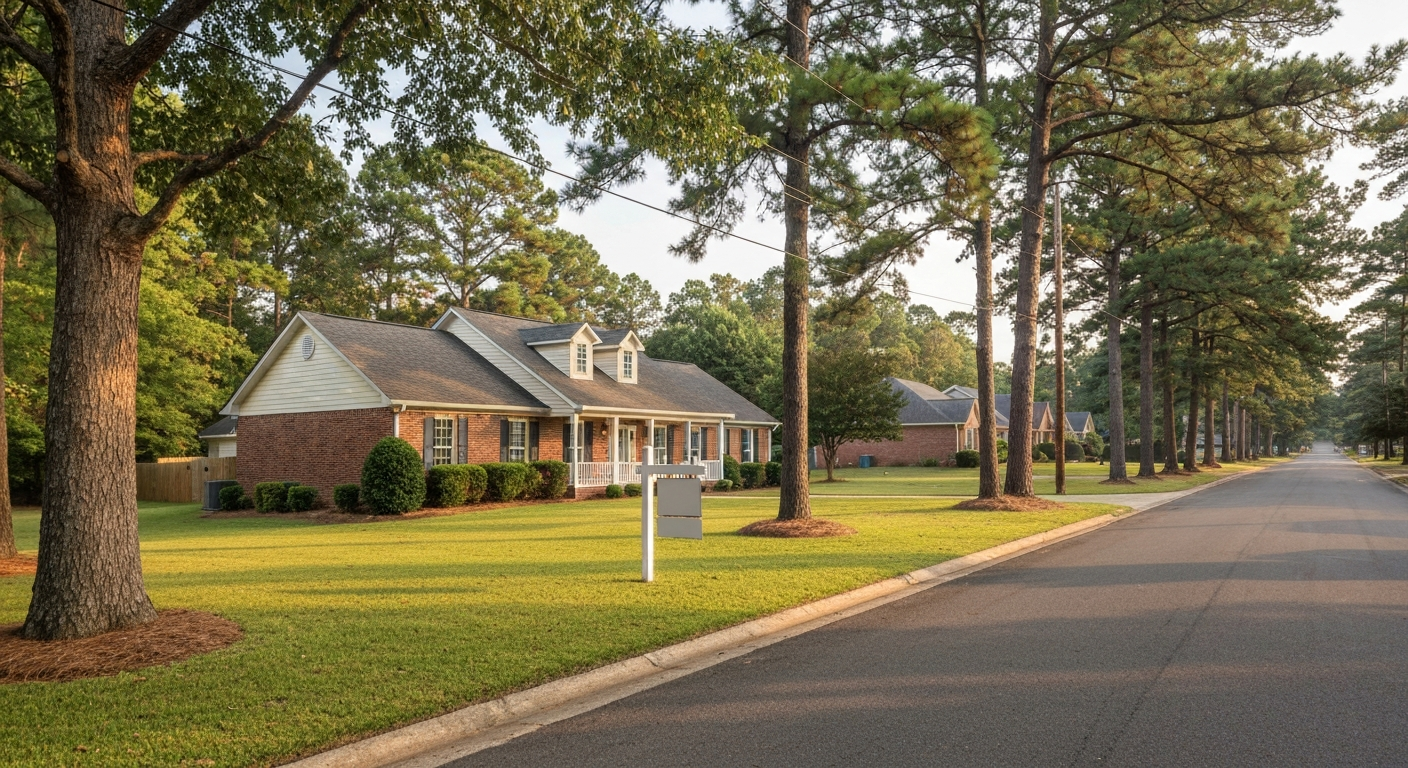
Should you rent or sell an inherited home in Augusta, GA? The answer turns on three specific factors: where the estate stands in Georgia's probate process, the property's stepped-up basis at the date of death, and what comparable homes are actually renting for in the current CSRA market. This guide walks through each one with real numbers and Georgia-specific legal context.
A parent dies and leaves a paid-off house in Evans. Or your aunt left you a 3-bedroom ranch in Martinez that hasn't been updated since 2008. The estate attorney says the deed transfer will be finished in a few months, and someone in the family says, "We should just keep it and collect rent."
Before that decision goes any further, you need to understand three things most heirs don't find out until it's too late: the probate step that must happen before you can legally rent or sell, the tax advantage you have right now that changes the longer you wait, and what the Augusta rental market will actually pay for that specific house in 2026.
This is not a general pitch for rental real estate. It's a post about the concrete decision in front of you right now — with real numbers from the CSRA market, the Georgia legal requirements, and the tax mechanics that determine which path makes financial sense.
Before You Can Do Anything: Georgia Probate and the Deed of Assent
Most families who call us about renting an inherited property are surprised to learn they can't start yet — and this part stops everything until it's resolved.
When someone dies owning real property in Georgia, that property doesn't automatically transfer to the heirs on the day of death. It passes through the estate, and the legal instrument that moves the title to you is called a Deed of Assent. The estate's executor or administrator executes this deed after the probate court approves the final distribution, and it must then be recorded in the Superior Court Clerk's office in the county where the property is located — Columbia County, Richmond County, Aiken County, or wherever the house sits.
Until that deed is recorded, title is not legally marketable. You cannot sell the property. You cannot finance it. In most cases, you cannot execute a legally binding lease on it.
What does Georgia probate actually require? Under O.C.G.A. Title 53, the process includes a mandatory 4-month creditor claim period that cannot be shortened regardless of how simple the estate appears. After that period, and after creditor notices are published in the county newspaper and sent to known creditors, most straightforward estates in Columbia County or Richmond County close in 6–12 months total. Contested estates, missing heirs, or significant outstanding debts can stretch that to 18 months or more.
That timeline matters for your rent-or-sell decision in a specific way. If you're planning to sell quickly and capture the stepped-up basis (more on this below), a 10-month probate clock is already running from the date of death. If you want to rent the property, that clock doesn't block your planning — but it does block your first lease signature.
Georgia has no state inheritance tax and no state estate tax, so heirs don't face a state-level death tax on the property's transferred value. What you will face is income tax on any rental income you collect, and capital gains tax on any appreciation above your stepped-up basis when you eventually sell.
Immediate steps to take:
- Contact the estate attorney or the county Probate Court and get the current status in writing.
- Ask specifically: when will the Deed of Assent be executed and ready to record?
- Once recorded, get a certified copy from the Superior Court Clerk. This is the document that title companies, lenders, and property management firms need to verify your ownership.
If there is no will, Georgia's intestate succession rules under O.C.G.A. § 53-2-1 determine who inherits. Co-heirs (multiple siblings, for example) must all agree before a property management company can take on the rental — one objecting co-owner makes the listing legally problematic.
The Tax Picture Is Different When You Inherit
The single biggest tax advantage you have right now — and the one most heirs don't fully grasp — is the stepped-up basis.
When you inherit property, the IRS resets your cost basis to the property's fair market value on the date of the original owner's death. Not the price they paid in 1988. Not whatever the mortgage balance was. The fair market value on the date of death, per IRC § 1014.
Here's what that means in practical terms for an Augusta-area property:
Say your parent bought a house in Evans in 1994 for $130,000. The home is worth $390,000 today. If they had sold it, they would have faced a $260,000 taxable capital gain (less any depreciation already taken). But because you inherited it, your basis resets to $390,000. If you sell the home within the next year or two for $400,000, your taxable gain is only $10,000.
That's a legally legitimate advantage the IRS builds into the inheritance rules. It does not expire immediately — but the clock starts moving the day you inherit. Every year you hold the property, any additional appreciation above that $390,000 becomes a future taxable gain.
When you rent the property instead of selling:
Your stepped-up basis becomes the foundation of your depreciation schedule. Under IRS rules for residential rental property (see IRS Publication 527), the structure is depreciated over 27.5 years using MACRS. Only the structure depreciates — not the land. If your stepped-up value is $390,000 and land accounts for roughly $70,000 of that, your depreciable basis is $320,000, generating approximately $11,636 per year in depreciation deductions that offset your rental income on Schedule E.
That's real money against your tax bill — but it comes with a deferred cost called depreciation recapture. When you eventually sell a property that you've held as a rental, the IRS recaptures previously claimed depreciation at a federal rate of 25%. Georgia taxes capital gains as ordinary income at a flat 5.39% state rate in 2026, scheduled to decrease annually under HB 1437 per the Georgia General Assembly.
The key comparison in one table:
| Scenario | Capital Gains Tax Exposure | Annual Tax Benefit |
|---|---|---|
| Sell within 12–18 months of death | Near-zero (stepped-up basis fully utilized) | None |
| Hold and rent for 10 years | Gains above stepped-up basis + 25% recapture | ~$11,000–$15,000/year depreciation deduction |
| 1031 exchange at eventual sale | Deferred if exchanged into like-kind property | Carries forward into new property |
None of this is simple enough to run without professional guidance. Work with a CPA who specializes in residential rental real estate — not a generalist who handles W-2 returns. Our post on rental property tax deductions for Georgia landlords covers the full menu of deductions once you begin renting, including mortgage interest, insurance, repairs, and management fees.
This is general guidance from a property manager — not legal or tax advice. Talk to a Georgia CPA and a real estate attorney for advice specific to your situation.
What Your Inherited Home Could Rent For in the CSRA
Before making a financial decision, you need a realistic rent figure — not a rough guess. "It might rent for $1,800" and "it will lease in under three weeks at $2,100" are very different inputs to the same decision.
Here's what the current CSRA single-family rental market looks like for 3-bedroom homes in 2026:
| Area | Typical 3BR/2BA Monthly Rent (2026) |
|---|---|
| Evans, GA (Columbia County) | $1,900–$2,300 |
| Martinez, GA (Columbia County) | $1,800–$2,200 |
| Grovetown, GA (Columbia County) | $1,600–$1,950 |
| Augusta / Richmond County | $1,400–$1,700 |
| North Augusta, SC (Aiken County) | $1,700–$2,100 |
Evans and Martinez command premium rents because of their proximity to Fort Gordon commute corridors, Columbia County's employment base, and consistently low vacancy rates. A 3-bedroom home in good condition in those markets typically leases within two to three weeks. Augusta/Richmond County rentals are viable but carry higher vacancy risk and lower average rents due to older housing stock.
Condition matters enormously. An inherited home with a 2008 kitchen, original HVAC, and carpet throughout will hit the low end of those ranges — if it rents at all in its current state. A property that has been well-maintained and updated in the last decade can realistically command the upper end.
One critical note: Zillow's "Zestimate Rent" tool is unreliable for single-family homes in suburban CSRA markets. It averages too broadly and often misses neighborhood-level differences that a local property manager sees every week. To get an accurate number for your specific property, you need a comparative rental analysis from a manager who is actively placing tenants in your ZIP code.
Amber McBride at our office runs these analyses at no charge for owners considering management. Reach out via the contact page and we can turn one around quickly once you have a confirmed address and basic property details.

The Financial Case for Renting: When the Numbers Work
Renting an inherited home in the CSRA makes the strongest case when several conditions align:
The property is in rentable condition — or close to it. A home that needs $25,000–$40,000 in deferred maintenance to pass a basic habitability inspection changes the cash flow math entirely. Before assuming renting is the better path, get written estimates for any make-ready work required. Our pre-rental property prep checklist outlines the typical inspection items.
Cash flow is genuinely positive after real expenses. Run this math without optimism:
- Monthly rent: e.g., $2,000
- Property management fee (8–10%): -$180
- Property insurance (landlord policy): -$100
- Property taxes: -$150
- Maintenance reserve (plan $100–$150/month for a single-family home): -$125
- HOA dues if applicable: varies
- Mortgage payment if the property isn't paid off: varies significantly
For a $2,000/month Evans rental with a $150,000 balance at 6.5% interest, the mortgage payment alone is roughly $1,025. Add $180 management, $100 insurance, $150 taxes, $125 maintenance reserve — and your monthly outflows total approximately $1,580, leaving net cash flow of $420/month. That's worthwhile. But if the remaining mortgage balance is $240,000, that math flips negative.
You're comfortable with a 5–10 year horizon. Rental real estate builds wealth gradually through principal paydown, depreciation benefits, and steady appreciation. If the plan is to hold for 18 months and sell, the transaction costs alone — make-ready, leasing fee, eventual sale commission — likely exceed the net cash flow generated in that window. Renting as a strategy earns its cost only with meaningful hold time.
You want to defer the capital gains decision. Some heirs aren't ready to close the chapter on a family property. Renting provides income while you decide. Just be clear that renting starts the depreciation recapture clock — the longer the rental hold, the larger the recapture on eventual sale.
When you call our office, Noah McBride typically handles the initial consultation personally for inherited-property situations. The legal and tax nuances make it worth the extra time up front, before a management agreement is ever signed.
The Financial Case for Selling — and When It Wins
Selling is the right answer more often than heirs expect, and recognizing when to take it avoids a long, costly path to the same outcome.
When make-ready costs are high. If the property needs a new roof, foundation work, kitchen replacement, or major systems overhaul, spending $40,000+ to bring an inherited home to rentable condition — at current contractor prices in the Augusta area — frequently makes less financial sense than a fair-market sale and a clean exit. At today's Columbia County market values, a buyer can absorb some of that deferred maintenance in the price negotiation.
When heirs need the liquidity. A clean cash distribution of a $400,000 property among three siblings is final. Ongoing rental income shared among co-heirs with different tax situations, different opinions about the property, and different degrees of involvement is complicated. Disagreements over rent-readiness, repairs, and management decisions have ended more than a few family relationships.
When the property is in Richmond County rather than Columbia County. Richmond County/Augusta city rentals are workable, but the vacancy risk is meaningfully higher, maintenance costs tend to be greater due to older housing stock, and average rents are $300–$500/month lower than Columbia County for comparable square footage. Over a 10-year hold, that differential adds up.
When you live out of state and won't use a property manager. Long-distance self-management of a CSRA rental is genuinely difficult. A 2 a.m. HVAC failure during an Augusta August is not a problem you want to solve from another time zone. Professional management fees narrow the cash flow margins further. If you're out of area, the calculus tips toward selling unless the property is firmly in positive cash flow territory with management fees factored in.
If you decide to sell, consult a CPA about whether any Section 121 exclusion might apply — if you ever lived in the home as a primary residence, there may be a partial exclusion available, though the rules for inherited property and the two-year occupancy requirement require expert review for your specific situation.

What the Georgia Safe at Home Act Means If You Become a Landlord
If you decide to rent, you become a Georgia landlord subject to the Safe at Home Act (HB 404), which took effect July 1, 2024. For inherited properties — which sometimes haven't been occupied or updated in years — this statute carries particular weight.
The Safe at Home Act establishes Georgia's first explicit statutory habitability standard for residential rentals. The Georgia Appleseed Center for Law and Justice has published detailed guidance on its provisions. The National Low Income Housing Coalition described Georgia as one of the last states to establish these baseline standards when the law passed.
Here's what it requires from landlords:
- The property must be "fit for human habitation" when the lease is signed — not just structurally sound, but with functioning heat, cooling, plumbing, and electrical. The law applies to all leases signed or renewed on or after July 1, 2024.
- The landlord must maintain that standard throughout the tenancy, not just at move-in.
- Security deposits are capped at two months' rent. For a $2,000/month Evans rental, the maximum deposit is $4,000. This changed the prior practice of collecting larger deposits for older or higher-risk properties.
- Cooling is now an explicitly required utility under HB 404 — a notable change for Georgia, where summer heat makes HVAC failure a health issue, not an inconvenience. A landlord who allows an HVAC unit to fail and doesn't repair it promptly is in potential violation of the habitability standard.
- For non-payment evictions, landlords must now provide a specific written notice and allow a three-business-day cure period before filing a dispossessory action with the court. This doesn't mean tenants can simply ignore rent — it means the procedural box must be checked before you file.
For an inherited property that may have a 2006 HVAC system, aging water heater, or an electrical panel from 1995, the Safe at Home Act is not merely a compliance checklist — it's a practical scope-of-work list before you list. Our Georgia eviction process guide covers what happens if you eventually need to pursue a dispossessory action, but the goal with every inherited rental we take on is avoiding that process entirely through good tenant selection and a well-prepared property from day one.
McBride PM's pre-rental inspection specifically reviews properties against Safe at Home Act standards before we recommend a listing price or timeline. This protects owners from legal exposure and ensures tenants move into genuinely habitable homes.
The First 60 Days If You Decide to Rent
Once the Deed of Assent is recorded and you've made the decision to rent, here's the practical sequence:
1. Switch the insurance before the first tenant moves in. A homeowners policy does not cover a rental. You need a Georgia landlord dwelling policy — different coverage for a different use case. Contact your current insurer immediately and request a policy conversion or replacement quote. Expect slightly higher premiums to account for liability exposure with tenant-occupied status.
2. Get a real rental analysis — not a web estimate. Request a comparative market analysis from a property manager who has placed tenants in your specific ZIP code in the last 90 days. The difference between an accurate $2,050/month analysis and an optimistic $2,300 estimate is 45 extra days on market and a price reduction.
3. Complete a pre-rental inspection against Safe at Home Act standards. Is the HVAC functional and recently serviced? Is the water heater within its rated lifespan? Are smoke detectors present in every bedroom? Is there any visible mold, standing water, or structural issue? These aren't optional — they're the law, and addressing them before listing avoids lease complications later.
4. Decide on management. If you live in the CSRA and have time, self-management is possible — but read our post on why to hire a property manager first. The hidden costs of self-management (vacancy time, turnover, legal exposure, time) often exceed the 8–10% management fee. For anyone managing alongside a full-time career or living out of the area, professional management almost always pays for itself.
5. Screen tenants with consistent, written criteria. For first-time landlords, this is where mistakes happen. Read our overview of the tenant screening process in Augusta and download our public screening standards as a reference for what a professional process looks like.
Our CSRA Landlord Field Guide covers the full operational setup for new landlords — lease structure, move-in inspections, Georgia law basics, and owner reporting. It's 12 pages and addresses most of what you'd need to know in the first 90 days of owning a CSRA rental.
Ready to find out what your inherited property could rent for?
McBride Property Management provides free rental analyses for owners weighing the rent-or-sell decision. We'll give you a realistic comparable-market rent figure, an honest assessment of the property's make-ready requirements, and a straight answer on whether renting makes financial sense in the current CSRA market. Call us at (706) 339-2874 or submit your property details online — no obligation, and no pitch until you're ready.
Download our CSRA Landlord Field Guide to see what professional property management looks like from day one.
Noah McBride, Broker McBride Property Management 706.339.2874 Guiding you home.
Ready to Talk Property Management?
McBride Property Management handles the details while you enjoy the returns.
Talk to our team about your property