What Georgia Landlords Owe When They Sell a Rental Property
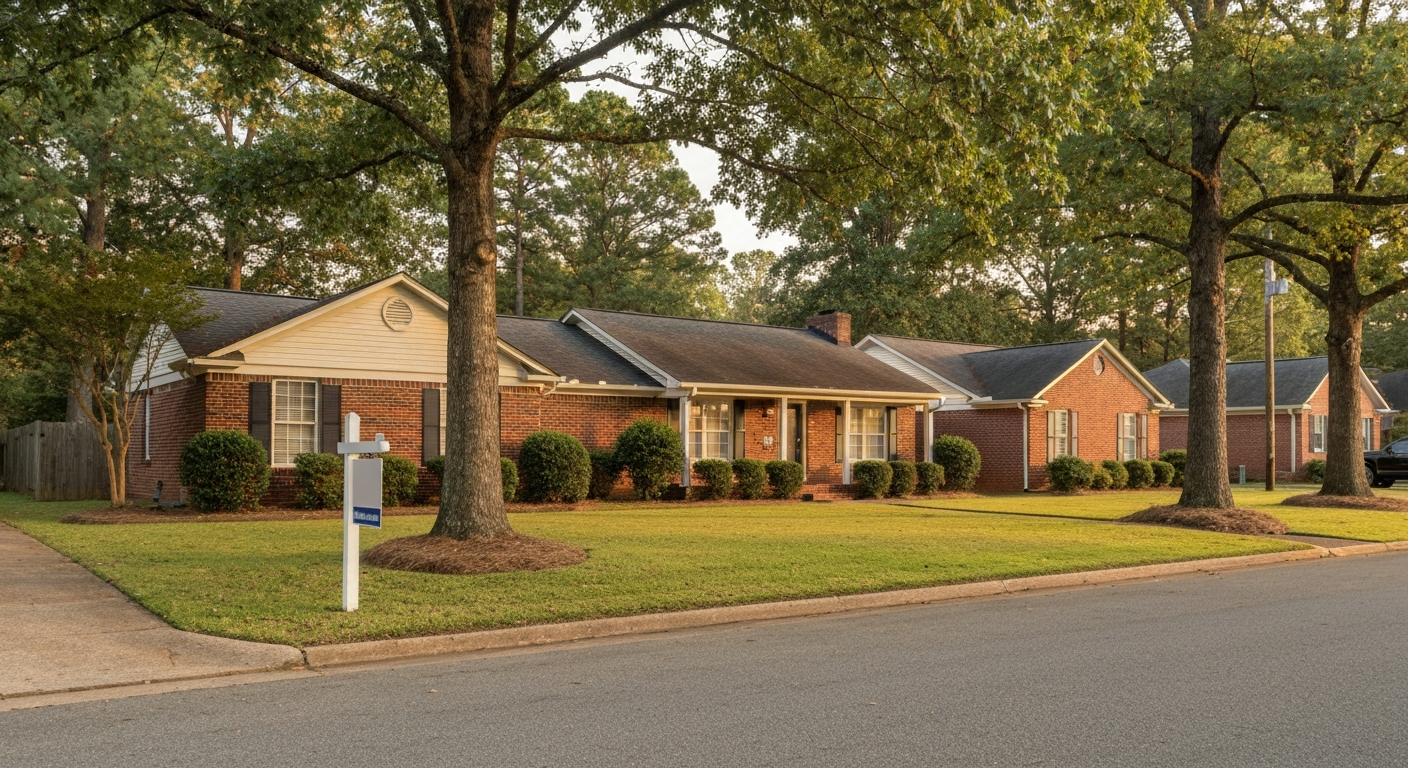
What taxes does a Georgia landlord owe when selling a rental property? You face two separate federal taxes — unrecaptured Section 1250 gain (depreciation recapture) taxed at up to 25%, and long-term capital gains on appreciation above that at 0%, 15%, or 20% depending on income — plus Georgia's 4.99% flat state rate on the full gain. Understanding all three before you close prevents a five-figure tax surprise.
You've been a steady landlord for six years. The three-bedroom in Evans you bought in 2019 has appreciated nicely. Interest rates have made a trade-up harder, you're tired of coordinating contractors, and selling feels like the right move. The equity is yours — why not cash out?
Before you sign a listing agreement, there's a tax calculation that determines what you actually keep. Landlords who skip this math often walk away from a closing table believing they cleared $50,000 and find out weeks later that they owe $20,000 or more to the IRS and the Georgia Department of Revenue. The money was never really all theirs — they borrowed some of it from the tax code for six years, and now it's due back.
The culprit isn't a tax penalty or an unusual audit trigger. It's the interaction between two things that happen at opposite ends of ownership: the depreciation deductions you've been taking every year, which reduced your taxable income — and the recapture of those deductions that the IRS demands the moment you sell. If you haven't modeled this yet, do it before you make any listing decision.
How Depreciation Quietly Builds a Tax Liability
Every year you own a rental property, you're entitled to deduct a portion of the building's value as depreciation. The rationale is that structures wear out over time, and the tax code lets you recognize that wearing-out as an annual expense. For residential rental property, the schedule is 27.5 years under the Modified Accelerated Cost Recovery System (MACRS), using the straight-line method.
The math starts with your depreciable basis: your purchase price minus the land value, plus any capital improvements. Land is never depreciable. If you paid $285,000 for a home and the assessor allocates $57,000 to land, your depreciable basis is $228,000 — and your annual depreciation deduction is $228,000 ÷ 27.5 = $8,291 per year.
Over six full years of rental, that's $49,745 in depreciation deductions. If you were in the 22% federal tax bracket during those years, those deductions saved you roughly $10,940 in federal taxes — spread across six tax returns, a few hundred dollars here and there, easy to lose track of. Meanwhile, your adjusted basis dropped by the same $49,745.
Every dollar of depreciation you take is a dollar of basis you give back. And when you sell, lower basis means higher taxable gain. The IRS depreciation rules for rental property are designed this way deliberately: the tax savings you receive during ownership come back at sale, at a specific rate. Understanding that rate in advance changes the calculus entirely.
For a broader overview of all the deductions you can claim during the rental period — including bonus depreciation on improvements and the QBI deduction — see our Georgia landlord tax deductions guide.
Here is what the adjusted basis erosion looks like year by year on a typical Evans single-family rental:
| Year | Annual Depreciation | Cumulative Depreciation | Adjusted Basis |
|---|---|---|---|
| 2019 (purchase) | — | — | $285,000 |
| 2020 | $8,291 | $8,291 | $276,709 |
| 2021 | $8,291 | $16,582 | $268,418 |
| 2022 | $8,291 | $24,873 | $260,127 |
| 2023 | $8,291 | $33,164 | $251,836 |
| 2024 | $8,291 | $41,455 | $243,545 |
| 2025 | $8,291 | $49,745 | $235,255 |
This is general guidance from a property manager — not legal or tax advice. Talk to a CPA familiar with rental real estate and a Georgia-licensed attorney for your specific situation.
Three Layers of Tax When You Sell
When a Georgia landlord sells a rental property held longer than one year, the total gain splits into components taxed at different rates. Most landlords think of this as one capital gains number. It isn't — it's three stacked charges, and the depreciation portion is taxed at the highest rate of the three.
Layer 1: Unrecaptured Section 1250 gain — up to 25%. This is the IRS's name for the portion of your total gain that equals the depreciation you claimed (or could have claimed). Congress created this special rate because depreciation reduced ordinary income during the rental period, and a straight capital gains rate at 15% would let landlords deduct at ordinary rates and pay back at capital gains rates — an unintended windfall. The 25% maximum rate closes that gap.
Importantly, 25% is the maximum, not a flat rate for everyone. If your marginal ordinary income tax rate is lower than 25% — if you're in the 22% or lower bracket — your recapture is taxed at your actual rate. But many P3 landlords in the $100,000–$200,000 income range find their effective recapture rate is exactly 25%.
Layer 2: Long-term capital gains on appreciation — 0%, 15%, or 20%. Any gain above the recaptured depreciation — the portion attributable to actual market appreciation beyond your adjusted basis — is taxed at the standard long-term capital gains rates. For 2026, per the Tax Foundation's 2026 tax bracket data:
- 0%: Taxable income up to $49,450 (single) / $98,900 (married filing jointly)
- 15%: Taxable income from those thresholds up to $533,400 (single) / $600,050 (MFJ)
- 20%: Above those thresholds
These brackets were made permanent under the One Big Beautiful Bill Act.
Layer 3: Georgia state income tax — 4.99% on everything. Georgia taxes capital gains from real estate as ordinary income at the state's flat rate. By 2026, under HB 463's accelerated schedule, Georgia's income tax rate reached 4.99%, ahead of the original 2029 target, according to the Georgia Department of Revenue. There is no preferential state rate for long-term capital gains. Your entire recognized gain — both the recaptured depreciation and the appreciation — is subject to 4.99% on your Georgia return.
Optional Layer 4: Net Investment Income Tax — 3.8%. If your modified adjusted gross income exceeds $200,000 (single) or $250,000 (married filing jointly), an additional 3.8% NIIT applies to net investment income, which includes gains from rental property sales. For landlords above these thresholds, this adds to the total effective rate.
A Worked Example Using CSRA Numbers
The following uses hypothetical but realistic numbers for a well-maintained single-family home in Evans, GA. This is an illustration — your actual numbers depend on your specific purchase price, improvements, depreciation history, and selling costs.
The Property:
- Purchase price (2019): $285,000
- Land allocation: $57,000 (assessed)
- Depreciable basis: $228,000
- Annual depreciation: $8,291
- Years rented through 2025: 6 full years
- Total depreciation claimed: ~$49,745
- Selling price (2026): $340,000
- Selling costs (agents, title, closing): $20,400
- Net sale proceeds: $319,600
The Tax Math:
- Adjusted basis at sale: $285,000 − $49,745 = $235,255
- Total recognized gain: $319,600 − $235,255 = $84,345
That $84,345 gain splits:
- Depreciation recapture: $49,745
- Capital appreciation above recapture: $34,600
Federal tax (assuming 22%/15% brackets):
- Recapture: $49,745 × 25% = $12,436
- Capital gain: $34,600 × 15% = $5,190
- Federal subtotal: $17,626
Georgia state tax:
- $84,345 × 4.99% = $4,209
Total estimated tax: approximately $21,835 — a 25.9% effective rate on the gain.
The net equity increase after taxes on a $285,000 purchase that sold for $340,000 after six years? About $32,500 after covering selling costs and taxes. That's meaningful, but materially different from the $55,000 in gross equity growth that a simple purchase-price-to-sale-price comparison might suggest.

The "Allowed or Allowable" Trap
One of the most common and painful surprises in a rental property sale hits landlords who stopped claiming depreciation — or never knew they should take it.
The IRS requires recapture of depreciation that was "allowed OR allowable," per the IRS's published guidance on property basis and home sales. This means if you owned a rental in Grovetown for eight years and never once took the depreciation deduction — because your preparer missed it, or because you didn't know to ask for it — the IRS still reduces your adjusted basis by everything you could have deducted. You owe the recapture tax as if you had taken every deduction.
You get the worst of both worlds: no tax savings during ownership, and the full recapture bill at sale anyway.
This happens more often than you'd expect. Landlords who converted a personal residence to a rental and kept using the same tax preparer who handled their personal returns sometimes don't have depreciation set up correctly. Accidental landlords who inherited a property and didn't establish an accurate cost basis at the time of inheritance are especially at risk.
The fix — if you catch this before you sell — is IRS Form 3115, the Application for Change in Accounting Method. This allows you to retroactively catch up on missed depreciation in the current tax year rather than amending multiple prior returns. It's not simple, but it means you at least collect the deductions before sale rather than just paying the recapture. This requires a CPA familiar with rental real estate, not a general tax preparer.
If you've been working with McBride Property Management, your AppFolio owner account contains a documented income and expense history for every year under management. Amber McBride, our Operations Manager, can generate an ownership summary on request — which is often the starting point CPAs use when preparing to calculate the basis on an upcoming sale.
Georgia's State Tax: No Capital Gains Break
Property investors from other states are sometimes surprised to learn that Georgia taxes long-term capital gains from real estate as ordinary income — no preferential state treatment for how long you held the asset.
This contrasts with the federal system, which gives a meaningful reward for long-term holding through the 0%/15%/20% capital gains brackets. At the state level in Georgia, a rental held for two years and a rental held for twenty years both face the same 4.99% flat rate on the realized gain.
For out-of-state owners of CSRA rental properties — a significant segment of Augusta's landlord base, given the volume of PCS-departing military homeowners who hold their homes from other duty stations — Georgia still taxes the gain because the property is located in Georgia. You'll report the gain on a Georgia nonresident return and apply for a credit against your home state's income tax, subject to your home state's rules.
For landlords considering a 1031 exchange from a Georgia rental into a South Carolina property in the North Augusta area, note that South Carolina also taxes capital gains as ordinary income, at a top rate of 6.4% for 2026. The calculation runs differently there, but the structural issue — no state-level capital gains preference — is similar.
Strategies to Defer or Reduce the Bill
You don't have to pay the full bill the year you sell. Three strategies are worth modeling before you commit to an outright sale.
1031 Exchange: Defer the entire gain. Under IRC §1031, exchanging your rental for another like-kind investment property within the required deadlines — 45 days to identify the replacement property, 180 days to close — defers both the capital gains tax and the depreciation recapture tax. The deferred gain carries forward into the replacement property's basis. You don't eliminate it; you roll it. But rolling it gives you the continued use of that capital, often for decades, and a future sale can be deferred again into another 1031.
For landlords who want to exit an Augusta-area property but remain in real estate, a 1031 exchange into a different market or a higher-quality asset is usually the most powerful tool available. See our full breakdown in the 1031 exchange guide for CSRA rental investors.
Installment Sale: Spread the gain across years. If a buyer qualifies for seller financing, an installment sale lets you receive the purchase price over multiple tax years. The capital appreciation portion can be spread across years, potentially keeping some of it in a lower bracket — including years where the gain qualifies for the 0% federal capital gains rate. Note that the recaptured depreciation must be recognized in full in the year of sale under installment sale rules for real estate, so this strategy helps more with the appreciation layer than the recapture layer.
Hold to Death: The stepped-up basis reset. Under current federal law, assets held at death receive a step-up in basis to their fair market value at the date of death. If you hold the rental and leave it to your heirs, your heirs' basis becomes the date-of-death value — eliminating all accumulated depreciation recapture and unrealized capital gain in a single step. The IRS effectively forgives the deferred liability. This is sometimes called the "die with it" strategy in estate planning, and it's a real, codified mechanism.
This approach requires no liquidity need from the rental during your lifetime, and it requires estate planning coordination — including potentially a trust structure to ensure the property passes efficiently. It's most appropriate for landlords who view the rental as a long-term legacy asset rather than a vehicle for current income.

When Selling Still Makes Sense Despite the Taxes
None of this analysis is an argument against selling. Sometimes the tax bill is worth paying.
Consider a landlord who has owned a Martinez or Grovetown rental since 2017. The home needs a roof, the HVAC is aging, rent growth in the submarket has plateaued, and the active management workload has increased. Even after a $20,000+ tax bill, selling and deploying the after-tax equity into a better-capitalized position — a newer property, a different market, a passive real estate fund — may produce better net returns over the next decade than continuing to hold a depreciating-condition asset.
The Columbia County for-sale market in mid-2026 is softer than recent years. Inventory has risen, and homes are sitting longer than they did during the 2020–2023 run-up. That softness gives buyers more negotiating power, but doesn't eliminate the fundamental demand base in the CSRA — Fort Gordon, the Savannah River Site, Augusta University Medical Center, and Plant Vogtle's permanent operations workforce aren't going anywhere. A well-maintained single-family rental with a current tenant, priced appropriately, still attracts buyers. For a detailed look at why Columbia County fundamentals remain sound, see our analysis of why Columbia County outperforms Augusta for rental investors.
The sell-vs-hold calculation is ultimately a math problem, not an instinct problem. Our Operating Expenses Worksheet includes a section that models the net present value of continued rental cash flows against an after-tax sale scenario — useful if you're trying to make this decision with actual numbers.
Records You Need to Calculate This Accurately
You cannot calculate your depreciation recapture without accurate records. Before any listing conversation with a CPA or a real estate agent, pull together:
- Original closing disclosure or HUD-1 from the purchase, showing the purchase price and any acquisition costs that were added to basis
- A list of capital improvements — new roof, HVAC replacement, kitchen renovation, added square footage — with receipts, because each one increases your basis and reduces the eventual gain
- All Schedule E filings from your tax returns during the rental period, confirming exactly how much depreciation was claimed each year
- Assessment records showing land vs. building value, which supports your original depreciable basis allocation
- IRS Form 4562 from any year you took bonus depreciation on components under the 100% bonus depreciation provisions
The cleaner your records, the more accurate your pre-sale tax estimate — and the better positioned your CPA is to find legitimate strategies. A missing capital improvement receipt (say, a $12,000 HVAC replacement in 2022 you forgot to document) translates directly into a higher taxable gain.
For a complete reference on managing the financial side of CSRA rental ownership, download the CSRA Landlord Field Guide. Our owner resources page also has links to the maintenance request documentation and inspection forms that create the paper trail your CPA will ask for.
Noah McBride and the team at McBride Property Management aren't CPAs, and this post is not tax advice — get a CPA who specializes in rental real estate before you make any sale decision. But we can tell you, from years of working with Columbia County and Richmond County landlords through property sales, that the landlords who handle this well are the ones who ran the math before they listed, not after.
Thinking about selling your Augusta-area rental property? Run the real numbers first.
McBride Property Management helps you document and organize the records that make your pre-sale tax analysis accurate — and coordinates the transition so a tenant-occupied sale runs smoothly. We're not accountants, but we work alongside owners and their CPAs at exactly this decision point.
Call (706) 339-2874 or request a free consultation online. If you're on the fence between selling and continuing to rent, we'll show you the current rent comp and cash flow projection for your property so you're comparing real scenarios, not guesses.
Noah McBride, Broker McBride Property Management 706.339.2874 Guiding you home.
Ready to Talk Property Management?
McBride Property Management handles the details while you enjoy the returns.
Talk to our team about your property