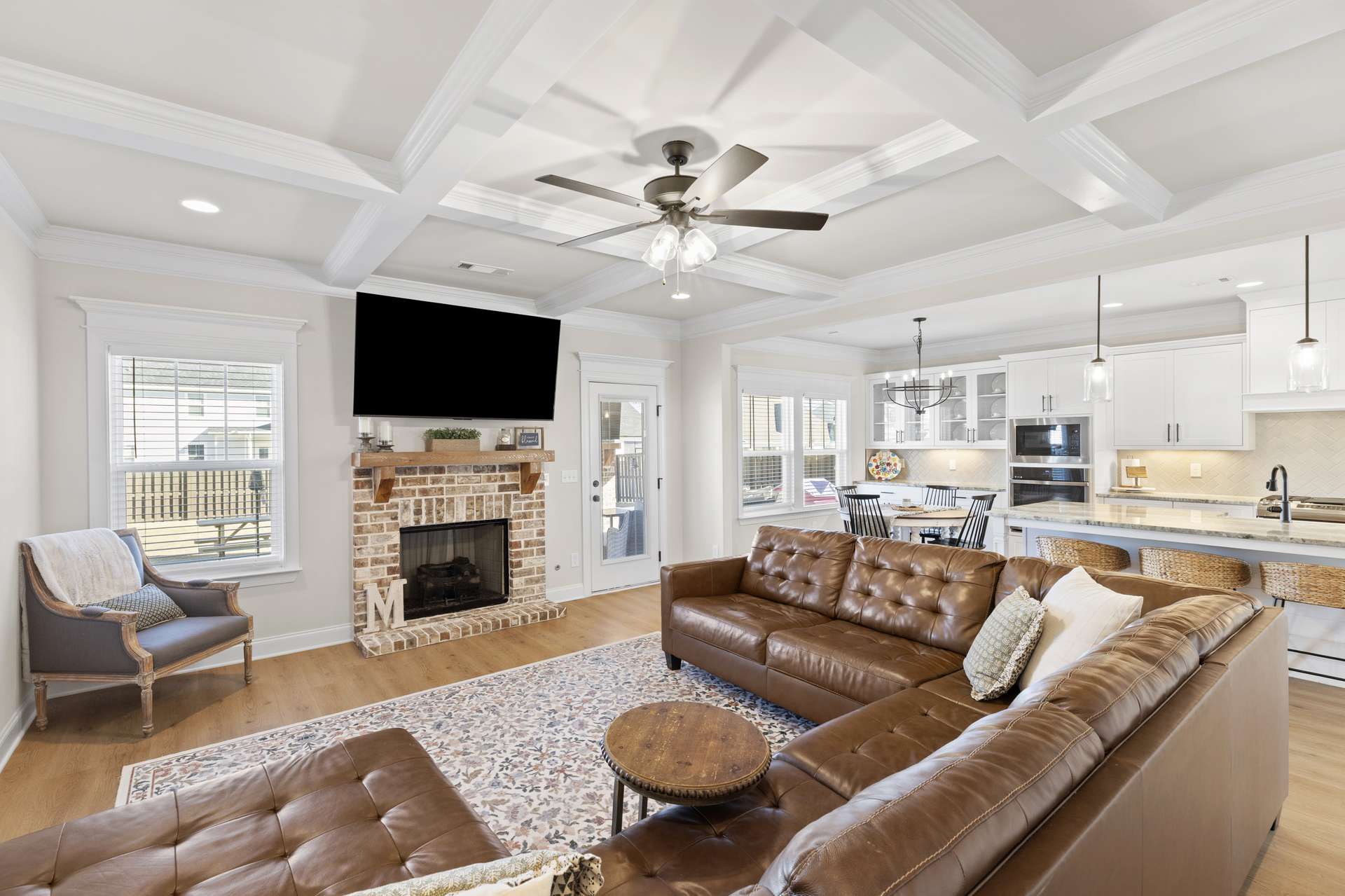
How do you price a rental property for the first time in Augusta, GA? Start with live comparables from Zillow, Apartments.com, or Zumper — 5–10 active listings within a half-mile, same bed/bath count, similar condition. In late 2026, three-bedroom single-family homes in the Augusta metro average $1,500–$1,750/month, with Columbia County (Evans, Grovetown) pricing 10–15% above Richmond County equivalents. Adjust for features like a garage, in-unit laundry, and fenced yard, then watch inquiry volume in the first five days as your real-time pricing signal.
You didn't plan to own a rental property. You planned to sell the house, or to return to it eventually, or to pass it along — and then the plan changed. A job relocation materialized faster than expected. A divorce finalized. The sale fell through three times and you're tired of waiting. Now the house is sitting there and you're trying to figure out what to charge.
Here's the part most accidental landlords don't expect: setting rent is harder than it looks, and the most common mistake isn't underpricing. It's overpricing because you're working backward from costs that have nothing to do with what a tenant will pay.
This guide is for property owners doing this for the first time in Augusta, Evans, Grovetown, and the broader CSRA. It covers how to find real market data, how to adjust for your specific property, what pricing signals to watch in the first week, and why the most expensive mistake is the one you don't see until month two — the vacant month.
The Emotional Pricing Trap That Costs First-Time Landlords the Most
Overpricing a first rental is nearly universal. It happens because you know what the house is worth to you — the kitchen remodel, the new roof, the years of mortgage payments, the school district you chose carefully — and you unconsciously translate that into what you think a tenant should pay.
Tenants don't factor in any of that. They see square footage, beds, baths, garage, fenced yard, proximity to Fort Gordon or the Savannah River Site, and four other listings at similar prices. If yours is the most expensive among comparable options and doesn't clearly justify the premium, it sits vacant.
Every vacant month in Evans or Grovetown costs real money. If your home should rent for $1,600/month and sits empty for six weeks because you listed at $1,900, you've lost $2,400 — and future months will almost certainly bring a tenant at $1,600 anyway. The math never works out in favor of overpricing.
The second trap is pricing to your mortgage. Your mortgage balance is not a market signal. If you owe $1,450/month in principal, interest, taxes, and insurance, but comparable homes nearby rent for $1,250, the rental market doesn't adjust to accommodate your debt service. Understanding this gap before you list — and deciding clearly whether renting makes financial sense — is the foundational question. Our rental property cash flow analysis guide walks through the full math if you want to run the numbers first.
The Four Data Sources That Actually Tell You What to Charge
You don't need a subscription service or a real estate license to research rental comps in the CSRA. You need four free sources used together.
1. Zillow active rental listings. Go to zillow.com, select "For Rent," and filter by your home's bed/bath count and property type (single-family). Set a radius of a half-mile to one mile from your address. Look at asking prices, square footage, days on market, and condition from photos. Zillow also publishes its Zillow Observed Rent Index (ZORI), which as of mid-2026 showed an average asking rent across Augusta of approximately $1,479/month for all home types, with 3-bedroom single-family homes trending in the $1,500–$1,750 range.
2. Zumper and Apartments.com. These two platforms capture a different slice of the market than Zillow, including professionally managed rentals that don't always appear on Zillow. Zumper's Augusta rent research reported a median rent of approximately $1,350/month as of June 2026, up about 8% year over year. For Evans and Grovetown, expect a 10–15% premium above that median for comparable single-family homes in Columbia County — which has lower vacancy and higher demand from Fort Gordon families and the growing Wellstar Columbia County Medical Center workforce.
3. ZIP-code-filtered listings. Columbia County rental listings skew toward newer construction and consistently price above Richmond County. When pulling comps, filter by ZIP code: Evans (30809), Grovetown (30813), and Martinez (30907) so you're comparing to your actual submarket rather than mixing in Augusta city comps that may be $200/month lower for equivalent square footage.
4. HUD Fair Market Rents. The HUD FMR tables for the Augusta-Richmond County metro set the voucher payment standard for Housing Choice Voucher tenants. FY2026 figures show $1,463 for a 3-bedroom in Richmond County. These figures are below typical open-market rates and serve a different purpose — they're the floor for Housing Choice Voucher-eligible tenants, not the ceiling for market-rate pricing. Include them as context, not as a target. Our post on Housing Choice Vouchers in the CSRA explains when FMR matters to your pricing decision.
How to Read CSRA Rental Comps Without Getting Fooled
Comparing listings looks simple until you realize how many variables affect the number. Two homes on the same street can legitimately be priced $200/month apart based on factors that don't appear in the headline rent.
Days on market is the most useful signal. A listing priced above market shows up as high days on market — 30, 45, 60 days with no lease. If your comps have been sitting more than 21 days, they're overpriced for current demand and you should treat their asking price skeptically. Listings that lease within 7–10 days reveal the true clearing price of the market. This signal is available on Zillow under each listing's details page.
Square footage per dollar matters more than price alone. A 1,800-square-foot home in Grovetown at $1,700/month works out to about $0.94/sq ft. A 1,400-square-foot home at $1,600/month is $1.14/sq ft. If your home is closer in size to the larger one, you can't realistically charge the per-square-foot rate of the smaller one and expect to lease quickly.
Photos reveal condition. A listing with dim photos of carpeted bedrooms, dated fixtures, and no mention of laundry hookups should price below a home with LVP floors, stainless appliances, and a two-car garage. Compare condition as carefully as you compare square footage.
| Feature | Typical Monthly Premium in the CSRA |
|---|---|
| Attached 1-car garage | +$50–$75 |
| Attached 2-car garage | +$75–$125 |
| In-unit washer/dryer (appliances included) | +$75–$100 |
| Washer/dryer connections (hookups only) | +$25–$50 |
| Fenced backyard | +$25–$50 |
| Updated kitchen (quartz/granite, stainless appliances) | +$50–$100 |
| Fresh paint and new flooring | +$25–$75 |
| No garage, HVAC older than 12 years, dated kitchen | –$50–$150 |
These premiums are consistent with what McBride PM observes in day-to-day CSRA pricing. They're not universal guarantees — local pockets vary — but they give you a reliable adjustment framework.
For a more detailed look at how pricing fits into the full leasing process, the CSRA property marketing guide covers how photo quality, platform selection, and description language work together with price.
The 1% Rule Is a Floor Check, Not a Pricing Tool
You may have encountered the "1% rule" — the idea that a rental should generate monthly rent equal to 1% of the property's value. On a $200,000 home, that's $2,000/month.
The 1% rule is a quick investment screen for evaluating whether a property is worth buying, not a tool for setting rent. It doesn't apply to the CSRA single-family market in 2026. With Columbia County median home values ranging from $300,000 to $380,000 in Evans and Grovetown, the 1% rule would imply $3,000–$3,800/month — rents that simply don't exist for single-family homes in this market. If you're using the 1% rule to set your price, you will price yourself out of the market.
What the 1% rule does tell you: if market rent in your neighborhood is $1,600/month and your home's current value is $320,000, the gross yield is about 0.5%. That's below what active investors typically target when acquiring a new property. This doesn't necessarily mean you shouldn't rent it — for an accidental landlord who already owns the home and isn't choosing between this and another investment, the relevant math is different. But you should run the actual numbers. The McBride PM Operating Expenses Worksheet is free to download and designed exactly for this calculation.
This is general guidance from a property manager — not legal or tax advice. Talk to a Georgia CPA for your specific situation.
Seasonal Timing: The Hidden Variable in Your First-Year Rent
The CSRA rental market has a pronounced seasonal cycle, and November is one of the slower months. Understanding the cycle before you list prevents expensive mispricing.
April through July is peak demand. This is driven by two overlapping forces: Fort Gordon PCS cycles (most military families arriving for the summer PCS window) and school-year household transitions (families wanting to be settled before the August start). A well-priced, well-prepared listing in May can generate 10–15 applications within a week. You can hold the top of your comp range and still lease quickly.
August through September is the transition. Summer demand has crested. Price at your comp midpoint, not the top.
October through March is the slow season. Demand drops, the prospect pool shrinks, and listings that would have moved in seven days in June can sit for 35 days at the same price. A property listed today — in November 2026 — should price at or slightly below the midpoint of adjusted comps. Minimizing vacancy is the priority.
Here's the math: one vacant month at $1,600/month costs $1,600 in lost revenue and you still owe carrying costs. Pricing $75/month below the summer rate from November through February could be the difference between a 10-day vacancy and a 45-day vacancy — a net savings of over $1,700. The seasonal pricing decision is not about being generous; it's arithmetic.
Our post on when to raise rent on Augusta rentals goes deeper on how to time pricing changes around renewals and market shifts.
Your First-Week Pricing Signal
Once you list, the market gives you real data within days. Here's how to read it.
First 48–72 hours: A correctly priced CSRA rental generates at least 3–5 serious showing inquiries in the first week. If you're at zero after 5 business days — and your listing has professional photos, a complete description, and is posted on Zillow and Apartments.com — the price is almost certainly the problem.
Adjust in $50 increments. If there's no activity, don't drop $200 at once. A $50 reduction at day 5, and another if needed at day 10, is less alarming to prospects than a sudden large correction. Each drop resets your listing as "reduced" on Zillow, which drives a fresh wave of views.
Don't raise the price mid-listing. If inquiries flood in immediately, resist raising the asking price. Raising price after a listing goes live damages trust among prospects who already saw the lower number. Screen carefully among your current applicants and set the next lease at the higher price if market conditions support it.
The target window: The fastest-leasing CSRA single-family rentals in 2026 are signing leases within 7–14 days of listing. If you're at 30 days with no lease, something needs to change — price, photos, or both.
What a Rental Analysis Does That a Listing Search Doesn't
Searching Zillow for comps takes 20 minutes and gets you most of the way there. A professional rental analysis — the kind McBride PM provides free of charge — does several things a listing search can't.
It accounts for closed lease data, not just asking prices. Asking price and actual lease price are not the same. A home listed at $1,850 that leased at $1,675 after 40 days tells you something very different from the asking price alone. Property managers who work the CSRA market daily have visibility into actual lease transactions, not just what owners are hoping for.
It flags submarket differences within Columbia County. The Evans 30809 ZIP code tends to price higher than Grovetown 30813 for equivalent homes, even though both are in the same county with the same school district. The Evans, GA rental market report and Grovetown, GA rental market report cover these submarket differences in detail.
It removes the emotional variable. When it's your home, you see what it means to you. A property manager sees what a tenant will pay. For most first-time owners, a professional rental analysis is the cleanest way to get a number that's disconnected from ownership attachment.
If you want to understand the why-hire value of professional management before you decide, our owner FAQ page covers how McBride PM approaches pricing, screening, and lease management for owners who are doing this for the first time.
The Real Cost of Getting the Price Wrong
Let's put numbers to the stakes. Suppose you have a 3-bedroom home in Grovetown worth $1,625/month in today's market, and you list at $1,900 because that's what you need to feel good about the number.
| Scenario | Month 1 | Month 2 | Month 3 | Quarter Total |
|---|---|---|---|---|
| Listed at $1,900 — vacant 60 days, leases at $1,625 | $0 | $0 | $1,625 | $1,625 |
| Listed at $1,625 — leases in 10 days | $1,462 | $1,625 | $1,625 | $4,712 |
| Overpricing cost | –$3,087 |
The overpriced scenario costs nearly $3,100 in the first quarter alone — nearly two months' rent — before accounting for carrying costs during vacancy (mortgage, insurance, lawn maintenance, utilities if you're covering them). Over a full year, the overpriced strategy almost never closes the gap.
The true cost of managing your CSRA rental on your own includes pricing errors as one of the largest and least visible line items. A property manager who prices correctly the first time — and fills the vacancy in two weeks instead of six — typically more than covers their management fee in the first month.
For context on the full cost structure, also see the owner FAQ page for answers to common first-time questions about management fees, lease terms, and what happens if a tenant doesn't pay.
Ready to price your rental correctly before listing it? McBride PM provides a free rental analysis — a specific price range backed by live CSRA market data for owners in Evans, Grovetown, Martinez, Augusta, and across Columbia County. Download the Operating Expenses Worksheet to model the full picture, or reach out directly.
Request your free rental analysis — (706) 339-2874 · robert@mcbride-pm.com
Noah McBride, Broker McBride Property Management 706.339.2874 Guiding you home.
Ready to Talk Property Management?
McBride Property Management handles the details while you enjoy the returns.
Get a Free Rental AnalysisOr talk to our team about your property
Looking for a home to rent? See available rentals →