DSCR Loans for CSRA Rental Investors: How the Augusta Numbers Work in 2026
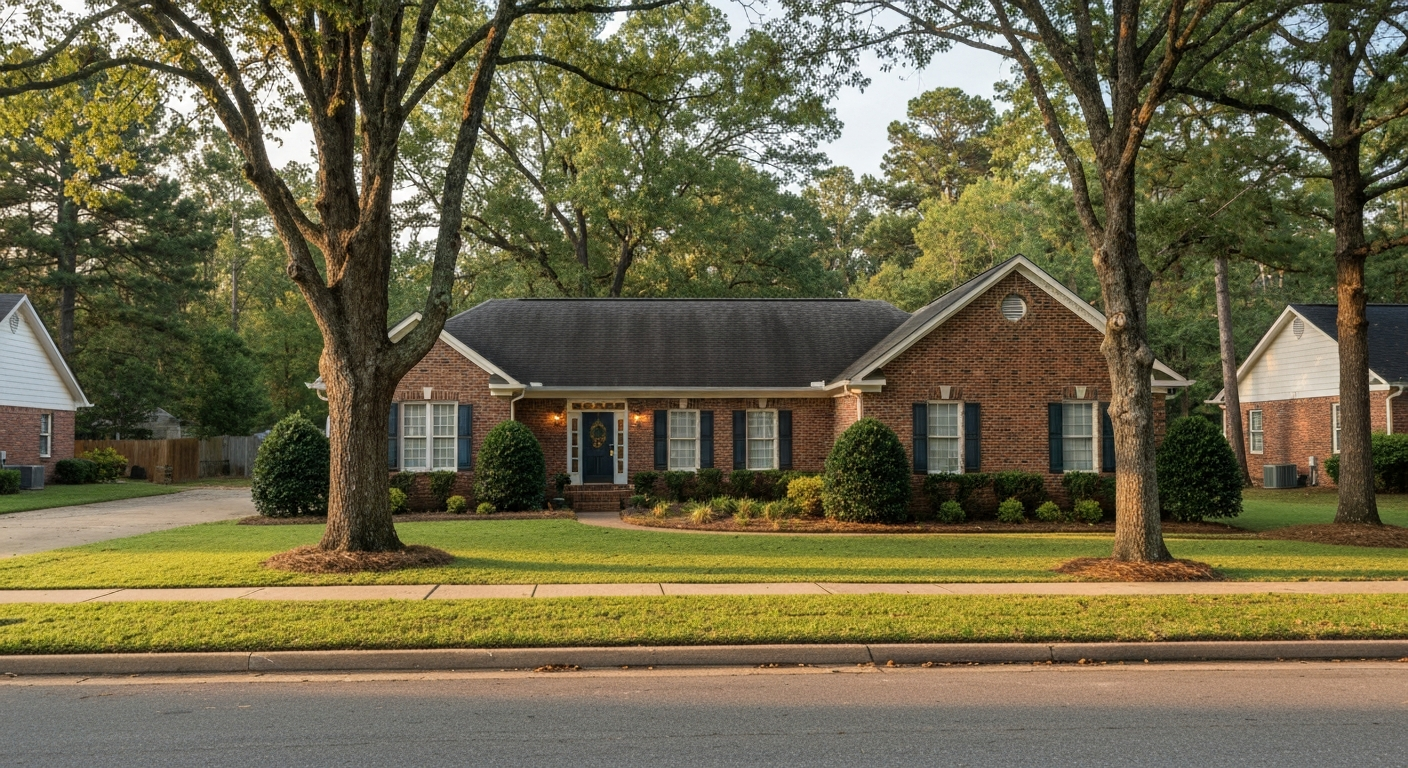
What is a DSCR loan for Augusta-area rental investors, and can CSRA properties qualify? A DSCR (Debt Service Coverage Ratio) loan lets real estate investors finance a rental property using the property's rent rather than personal tax returns or W-2s. In June 2026, fixed DSCR rates range from 6.125% to 7.5%, with a minimum ratio of 1.0 required by most lenders. Augusta's lower home prices — median around $193,000 in Richmond County — mean 3-bedroom rentals can reach the 1.0 threshold at 20% down. Columbia County properties typically need 25%.
You've been researching the CSRA rental market from a distance. You understand why the fundamentals are strong — Fort Gordon, the Savannah River Site, Augusta University Medical Center, and Columbia County's population growth create the kind of steady, employment-backed rental demand that doesn't depend on a single industry. What you haven't figured out is how to finance the deal cleanly when your personal income is complex: self-employment income, multiple LLCs, investment gains, real estate write-offs that depress your adjusted gross income.
That's the gap a DSCR loan fills. The lender ignores your personal income entirely. They underwrite the property instead. If the rent covers the payment, you qualify.
What most DSCR guides don't answer is whether the CSRA's actual price-to-rent ratios make qualification realistic. That's what this post addresses — with real numbers from the three submarkets Augusta-area investors ask about most: Augusta city (Richmond County), Grovetown, and Evans.
What a DSCR Loan Is — and Why Out-of-State Investors Use Them
A DSCR loan is a non-QM (non-qualified mortgage) product. "Non-QM" means it doesn't meet the Qualified Mortgage definition set by the Consumer Financial Protection Bureau — and specifically, it doesn't require the lender to verify your ability to repay through standard income documentation.
For a conventional investment loan, a lender pulls your W-2s, reviews two years of tax returns, calculates your debt-to-income ratio, and counts every rent payment you currently receive at a 75% discount. If you run a business, write off substantial expenses, or collect income from multiple streams that don't add up neatly on a 1040, conventional underwriting fights you.
DSCR underwriting skips all of that. No tax returns. No employment verification. No DTI calculation. The underwriter looks at one question: does the property's gross monthly rent cover its full monthly payment?
That simplicity is why investors with complex financial lives — self-employed, multiple LLCs, consulting income, investment-heavy tax returns — gravitate to DSCR loans. It's also the standard financing vehicle for out-of-state investors who are building a CSRA portfolio from New York, California, or Florida without the time or interest in multi-month conventional underwriting cycles.
According to Lendmire's Georgia DSCR loan program overview, Georgia DSCR loans are available statewide with loan amounts from $75,000 to $2 million, LTV up to 80%, 30-year fixed terms, and closing timelines of approximately two to three weeks. Minimum credit score at most programs is 660, though 740 and above unlocks the best rate pricing tiers.
The DSCR Formula: Exactly What Lenders Calculate
The ratio has four inputs — all drawn from the property, not from you.
DSCR = Gross Monthly Rent ÷ PITIA
PITIA stands for: Principal + Interest + Taxes + Insurance + Association dues (if any HOA or condo fee applies).
Gross monthly rent is market rent as determined by an independent appraisal — not what a current tenant is paying, and not what you expect to charge. The lender orders a rental analysis (Form 1007 for single-family) alongside the standard property appraisal. Whatever the appraiser concludes the unit would rent for in current market conditions is the numerator.
This matters for two reasons. If the current tenant is paying below-market rent, you benefit — the appraiser reflects what the unit would actually command today. And because it's third-party, the number isn't self-reported.
PITIA breaks down as:
- P+I: the actual loan payment at the quoted rate and term
- Taxes: annual property tax divided by 12
- Insurance: annual hazard insurance premium divided by 12
- Association: monthly HOA or condo fee, if any
Clear House Lending's 2026 DSCR requirement guide outlines the breakpoints that determine pricing:
| DSCR Range | Lender Interpretation | Typical Impact |
|---|---|---|
| Below 0.75 | Significantly cash-flow negative | Few programs available; very high rates |
| 0.75–0.99 | Sub-1 but viable | Specialty programs; 30–35% down required |
| 1.00–1.24 | Minimum pass | Qualifies at most lenders; standard pricing |
| 1.25–1.49 | Clean deal | Rate discount of 0.25–0.50% vs. 1.0 tier |
| 1.50+ | Strong deal | Best pricing; easiest approval path |
Running the Numbers on CSRA Properties
This is where most DSCR guides fail investors — they explain the formula but never show you whether the properties you're targeting pass. The following scenarios use verified data: Columbia County's effective property tax rate of approximately 0.87% (supported by a county millage rollback to 4.36 mills, per Columbia County's 2025 budget reporting), June 2026 DSCR fixed rates of approximately 7.125% for a 20%-down borrower with 660–700 credit, and current median rent figures for Augusta-area three-bedroom single-family homes.
| Submarket | Purchase Price | Down Payment | Est. PITIA | Market Rent (3BR) | DSCR |
|---|---|---|---|---|---|
| Augusta (Richmond Co.) | $205,000 | 20% — $41,000 | ~$1,461/mo | $1,500 | 1.03 |
| Grovetown (Columbia Co.) | $265,000 | 20% — $53,000 | ~$1,740/mo | $1,650 | 0.95 |
| Grovetown (Columbia Co.) | $265,000 | 25% — $66,250 | ~$1,625/mo | $1,650 | 1.02 |
| Evans (Columbia Co.) | $310,000 | 25% — $77,500 | ~$1,891/mo | $1,900 | 1.00 |
These are directional estimates based on June 2026 market conditions — your lender will use an appraisal and confirmed insurance quote for actual underwriting. Insurance estimated at $110–130/month depending on submarket.
The clear takeaway: Augusta city proper at 20% down is the most achievable path to 1.0 DSCR. Grovetown needs 25% down to cross the threshold. Evans is tight even at 25% and requires strong market rent documentation.
None of these produces the 1.25+ ratio that earns the best pricing — but none is the hopeless sub-0.75 situation that plagues investors in higher-cost markets. The CSRA sits in the "achievable with discipline" range.

Why CSRA Price Points Create a Genuine Advantage
The national median home sale price in mid-2026 sits around $400,000–$420,000. At that price, a 20%-down investor at 7.125% carries a PITIA well over $2,600 on a coastal or gateway-city property before taxes and insurance. Unless the unit rents for $2,700 or more per month, the math doesn't reach 1.0 — and in many markets, $2,700 rents are exceptional, not typical.
In Richmond County, the median sale price is approximately $193,250. Grovetown runs $265,000–$280,000. That's 35–55% below the national median — and CSRA rents don't fall proportionally. A three-bedroom house in Grovetown or Evans rents for $1,550–$1,900 per month, underpinned by sustained Fort Gordon demand.
Fort Gordon's 2026 Basic Allowance for Housing rates — published annually by the Defense Finance and Accounting Service — range from $1,206 per month for an E-4 without dependents to $2,298 per month for an O-5 with dependents, according to My Base Guide's Fort Gordon housing data. With quality three-bedroom homes in Evans or Grovetown renting for $1,700–$1,850 per month, BAH covers rent entirely for mid-grade NCOs and officers — which translates directly to low vacancy risk and consistent payment history.
Columbia County's effective property tax rate of approximately 0.87% — supported by the county's rollback of its maintenance and operations millage to 4.36 mills, the lowest in 35 years — keeps PITIA lower than comparable-priced communities in many other Georgia markets. A lower PITIA denominator directly improves the DSCR ratio without any change to purchase price or down payment.
The combination — lower prices, stable military-driven rents, and low property taxes — creates DSCR arithmetic that's more favorable than what investors find in higher-cost or lower-employment metros. The four demand anchors behind CSRA's resilient rental market explain in more detail why the underlying rental demand is structural, not cyclical.
When Your DSCR Comes in Below 1.0: Options That Still Work
If your target property's numbers land between 0.75 and 0.99, you're not out of options — but the loan structure changes.
Sub-1.0 DSCR programs. Several non-QM lenders offer programs down to 0.75 DSCR. The tradeoff is a higher interest rate (typically 0.5–1.0% above standard DSCR pricing) and more restrictive LTV, usually capped at 70%, meaning 30% down. If you're buying a property where current rents are below market and you plan to re-lease at current market rates after turnover, a sub-1.0 program bridges the transition.
No-ratio DSCR. Some lenders offer programs where rental income isn't used to qualify at all. Approval rests entirely on credit score, down payment (often 35%), and asset reserves. Useful for vacant properties or short-term rentals where market rent is difficult to appraise. Rates are higher, but the loan exists and closes.
Increase the down payment. The cleanest path when you're 5–8 points below 1.0: put 25–30% down instead of 20%. A larger down payment lowers your principal balance, which reduces P+I, which directly improves the ratio. At 30% down on a $265,000 Grovetown property at an improved 6.75% rate (reflecting the lower LTV), the estimated PITIA drops to approximately $1,515/month — comfortably below typical market rent of $1,650.
Target lower-priced inventory. Richmond County at $190,000–$210,000 produces better DSCR than Evans at $310,000 at equivalent rent levels. If passing DSCR underwriting is the primary constraint, Augusta city gives you more margin. The out-of-state investor's guide to buying CSRA rentals covers submarket trade-offs in more detail.
Market rent appraisal advantage. If the current tenant is paying below-market rent — common in properties that have never been professionally managed — the lender uses the appraiser's market rent figure, not the lease amount. A thorough market rent appraisal sometimes moves a deal from 0.92 to 1.05 without any change to purchase price or down payment. Discuss this scenario with your lender before assuming a borderline property doesn't qualify.
What a Local Property Manager Does for Your DSCR Application
This dimension rarely appears in DSCR financing guides.
A property management agreement is documentation that a licensed local professional has assessed the property and is prepared to manage its leasing and operations. It doesn't automatically improve your DSCR ratio, but it strengthens the overall loan package in two meaningful ways.
First, lenders and their underwriters view a professionally managed property differently for portfolio loans and repeat-borrower relationships. The presence of an experienced local manager signals that the property will maintain its rent schedule, that vacancy will be handled promptly, and that the lease and accounting records will be organized. That's a credit-quality signal even when it isn't written explicitly into the underwriting guidelines.
Second, if the property is already tenant-occupied under a McBride Property Management lease, the rent roll and lease documentation are organized in a standard form that lenders' appraisers expect. Amber McBride, our operations manager, oversees onboarding and maintains the records that matter when a lender or appraiser comes looking: current lease, rental ledger, vacancy history, and maintenance records. A messy or missing paper trail creates underwriting delays that cost you a rate lock.
If you're evaluating CSRA properties from out of state, contact McBride Property Management before your offer goes out. We provide a free rental market analysis — what a specific property would rent for in current market conditions, how long it typically takes to lease, and what professional management looks like for that asset class and location. That market rent opinion gives you a reliable numerator before you run your own DSCR calculation, and it gives your lender exactly what they'll need when they order the formal rent appraisal.
For a deeper look at the underlying cash flow mechanics before you run DSCR numbers, the CSRA rental property cash flow analysis walks through net operating income, cap rates, and expense benchmarks for Augusta-area single-family rentals.
You can also download the McBride PM Operating Expenses Worksheet — it contains benchmarked expense figures for CSRA properties that are useful inputs when you're stress-testing your DSCR projections.
2026 DSCR Loan Terms: What to Expect When You Apply
Practical details to have in hand before you call a lender:
Rate range. According to Home Abroad's June 2026 DSCR rate tracker, fixed DSCR loan rates for residential investment properties run approximately 6.125% to 7.5% as of this month. Adjustable-rate programs start around 5.125%. Rates run 0.5%–2% above equivalent conventional investment loans. Your specific rate depends on credit score, LTV, property type, DSCR ratio, loan size, and whether you accept a prepayment penalty (typically 3 or 5 years with a step-down structure).
Credit score. Minimum 620–660 at most lenders. 680+ opens more programs. 740+ gets the best pricing tier and makes 80% LTV more accessible. Georgia-specific non-QM lenders generally require 660 as the floor to access standard 80% LTV programs.
LTV and down payment. Standard is 75–80% LTV (20–25% down). Higher-credit borrowers with DSCR of 1.25+ may access 80% LTV more easily. Sub-1.0 DSCR programs typically cap at 70% LTV, requiring 30% down.
Prepayment penalties. Most DSCR programs include a 3-year or 5-year step-down prepayment penalty. Accepting a prepayment penalty typically lowers your rate by 0.25–0.75%. For investors who plan to hold for five or more years — standard in the CSRA buy-and-hold strategy — the rate reduction typically justifies the commitment.
Loan amounts. Georgia DSCR lenders typically work from $75,000 to $2 million. Given CSRA price points for single-family targets ($190,000–$320,000), you're well within standard program limits.
Property types eligible. Single-family residences, 2–4 unit properties, condos, townhomes, and short-term rentals with documented rental history all qualify under most programs.
Timeline. Expect 2–4 weeks from application to close once the rent appraisal is ordered and returned. DSCR closings are faster than conventional investment loans because underwriting skips the income documentation stage.
How DSCR Compares to Other Investor Financing Options
A quick frame for investors evaluating DSCR against the alternatives:
Conventional investment loan (Fannie Mae/Freddie Mac). Requires full income documentation, DTI under 45–50%, and significant reserves. Rates are 0.5%–2% better than DSCR. Best for investors with clean W-2 income and straightforward debt-to-income ratios. Most out-of-state investors with complex tax returns can't access this cleanly.
Portfolio lender (local bank). A local bank holds the loan in-house and sets its own underwriting criteria. Sometimes more flexible for specific deal types, but requires an existing banking relationship and in-person engagement. Rate is highly variable. Harder to execute remotely.
Hard money or bridge loan. Short-term (12–24 months), significantly higher rates (9–12%+), designed for transitional properties. Not suitable for a stabilized buy-and-hold strategy.
DSCR loan. No income verification, faster close, lower rate than hard money, and works for stabilized rentals. The cost relative to conventional is the rate premium — for investors who can't or don't want to document personal income, that premium buys real structural flexibility.
DSCR loans become particularly valuable from the second or third property onward, when conventional financing starts counting all your existing rental income at a discount and your DTI begins to compress your buying capacity. Building a CSRA portfolio of three to five single-family homes almost always means shifting to DSCR at some point in the acquisition sequence.
The CSRA landlord field guide covers the full operating picture for Augusta-area rentals — expenses, management structure, vendor relationships, and compliance considerations — and pairs well with the financing analysis in this post.
This is general guidance from a property manager — not legal or tax advice. For loan structuring that matches your specific financial situation, work with a licensed Georgia mortgage originator who specializes in non-QM investment products.
Ready to run the rental analysis before you call the lender?
If you're evaluating a CSRA property and want to know what the market rent would support — the actual numerator in your DSCR calculation — McBride Property Management provides a free rental analysis for serious investors. We manage single-family rentals across Augusta, Evans, Grovetown, Martinez, and North Augusta, and we can tell you what a specific property would rent for, how quickly it would lease, and what professional management looks like.
That analysis also gives you a ready-made reference when your lender orders the formal rent appraisal.
Request a free rental analysis or call us at (706) 339-2874.
Noah McBride, Broker McBride Property Management 706.339.2874 Guiding you home.
Ready to Talk Property Management?
McBride Property Management handles the details while you enjoy the returns.
Talk to our team about your property